A Manifesto
Marketing Is an Argument
A Note Before We Begin
I grew up in a small town in Virginia playing baseball and doing the things small-town kids do. Today, I'm a marketing guy who lives in San Diego with my wife and two kids.
This manifesto is me trying to figure something out. I've spent years helping businesses clarify their message, and at some point, realized I needed to clarify my own. Specifically, what I believe about how we should talk to people when we're asking them to buy.
I wrote it for anyone who's felt that twinge of discomfort when marketing advice starts sounding like manipulation advice, and wondered if there's another way.
I believe there is, and I think it's something people from very different starting points might agree on. In a time when we're divided over everything, that feels like a goal worth pursuing.
This manifesto wades into questions of ethics and meaning. I'm not a philosopher or a theologian. I'm probably wrong about parts of this, and am still working it out. But I'd rather put it out there than let the perfect become the enemy of the good.
If any of what's below lands, let me know.
— Billy
I. The Great Human Flattening
Watch out for the word "just." It's devious.
When someone uses that word, they're about to reduce something to its components, which all too easily strips away its meaning.
"Food? It's just protein, fat, and carbs."
"Marriage? It's just a piece of paper."
"Running? It's just numbers: speed, distance, heart rate."
"Your customer? They're just a data point."
"A human being? Just a bundle of neurons and chemicals."
This is The Great Human Flattening.
It's the systematic reduction of human depth into thin, measurable, controllable categories. You see it everywhere:
- Love flattened into dating app algorithms
- Wisdom flattened into life hacks
- Community flattened into "audience building"
- Grief flattened into wellness products
- Persuasion flattened into psychological manipulation
Although the Great Human Flattening is everywhere, it's out of control in my field of marketing.
I didn't notice it at first. I was too busy learning the craft, reading the books, following the formulas, and desperately trying to get my solo-business off the ground.
But eventually, the Flattening became too obvious to ignore.
I had to ask, "What's behind it?"
II. The Root Cause
What's behind the Great Human Flattening?
It can be summed up in one word: Reductionism
I used to be the worst reductionist. Not intentionally, but it was the only lens I had.
In my college biotechnology class, I looked through a microscope at thousands of algae cells, each packed with oil. This was clean oil, an alternative to fossil fuels, that could power our cars and homes.
Breaking things down to their component parts is a key step in the scientific method and works beautifully to understand the natural world and create solutions that improve our lives.
My mistake was believing I should apply this reductionist move across the board.
When I left the energy industry and started learning marketing, I read the books everyone recommended.
Influence, Predictably Irrational, The Illusion of Choice.
I used the techniques, and they worked.
But something felt off.
Ever heard this advice?
- "Push your customer's emotional hot buttons"
- "Hack your customer's brain"
- "Tap into their dopamine loop"
- "Trigger oxytocin to build trust"
- "Use reciprocity to make them feel indebted"
Do you see what these phrases have in common? They treat people as objects to be manipulated rather than minds to be persuaded.
This way of seeing makes more sense when you understand the world we were born into. We're the fish born into water that don't know they're in water.
III. How Dark It Gets
The reductionists said the quiet part out loud.
Sean Parker, Facebook's founding president, admitted:
"The thought process that went into building these applications was all about: 'How do we consume as much of your time and conscious attention as possible?' And that means that we need to sort of give you a little dopamine hit every once in awhile."
A company called Dopamine Labs, founded by two neuroscientists, built tools explicitly designed to make apps addictive. They named their AI "Skinner" after behaviorist B.F. Skinner, the man who famously taught pigeons to dance by starving them.
They even named their software "Dopamine API," which should scare the heck out of us.
Their founder, Ramsay Brown, said it plainly:
"As a NeuroEconomist, I used to study the hidden causes of our motivations and desires. Now, as a behavior designer, I use those causes to shape behavior."
Not persuade. Not communicate. Shape. He might as well have said control human behavior.
This is the vocabulary of programming.
What does this language assume about you and me? That we're the machines being programmed.
Those quotes are from 2017, only the beginning. If you think the weaponization of neuroscience has gotten less aggressive since then, you haven't been paying attention.
The reductionists' tools have only gotten sharper.
IV. "But It Works"
I can hear the objection already.
"But Billy, scarcity works. Psychological triggers get results."
Fair enough, let's talk about that.
When we say "it works," we're asking a utility-based question: Does this technique produce the desired outcome?
But there's a deeper question we're not asking: What does this technique assume about the person on the other end?
The countdown timer that resets every 10 minutes. Does it "work"? Maybe. But it assumes the person can't be trusted to make a reasoned decision. It assumes they need to be pressured into action, and that they're a stimulus-response machine.
Is that true?
I didn't have the language for this question until I discovered a field I'd written off my whole life.
V. Utility vs. Ontology
Even though I felt uneasy about these techniques, I didn't know any better. I thought, "This is what I need to do to be successful. This is all there is."
With my scientific background, I wrote off the humanities as fluff. I was a STEM guy through and through.
It wasn't until my mid-30s, when I'd started a family, hit some walls, and realized the usual approaches weren't working anymore, that I put down the business books and started reading people who lived centuries ago. That's when I discovered a field that rocked my world: philosophy.
Previously, when I heard the word "philosophy," I pictured Greeks in white robes who loved to hear themselves talk. It seemed like navel-gazing, not something practical. Not something relevant to my daily work of sending emails, building websites, and serving clients.
I couldn't have been more wrong.
Philosophy is the most practical field in the world. It's made up of subfields like ontology, a fancy word for a simple question: "What is real?" Epistemology asks, "What can humans know?" And ethics—which used to sound so boring to me—asks, "How should we act?"
Do you see how relevant these questions are to marketing? Why have we ignored them?
To be clear: I am not anti-science. The scientific method is the greatest tool we have for understanding the physical world, like those algae cells in my biotech lab. The problem is scientism: the belief that reality is limited to what we can measure. Bring that worldview into marketing and you start treating humans like chemicals in a beaker rather than people with agency. We don't need less science; we need more philosophy to tell us what that science is for.
"If nobody designed my brain for the purpose of thinking—if it's merely atoms arranging themselves—how can I trust my own thinking to be true? It's like upsetting a milk jug and hoping the way it splashes will give you a map of London."
A bit of history helps here. Psychology is a relatively new field, having split off from philosophy only 150 years ago. That split was part of a larger movement, the rise of scientific thinking, that we were all born into. This is the water we've been swimming in.
Psychology adopted the methods of science: observation, measurement, and control. It became, in many ways, reductionist.
When you step out of the water and look at marketing through the lens of philosophy, a new world opens, and both the problem and the solution become clear.
Let's start with the field of ontology. It asks, "What is true about reality?" Apply it to humans and ask, "What is true about a person? And what does this marketing technique assume about them?"
If it's true that humans are nothing more than bundles of chemicals, we have no reason to treat them ethically in marketing. Anything goes. "Whatever works" becomes the only standard.
"What works? What gets results?" These questions assume a frame of utility—measured by clicks, sales, and ROI.
Utility assumes: "If it works, it's okay to use."
That's utilitarian ethics, where the ends justify the means. But can you imagine applying the utility frame to all areas of life?
Imagine someone who wants intimacy badly enough to focus on getting what they want rather than whether it is freely given. The outcome occurs, but the means make it wrong.
Similarly, marketing is not just about outcomes. It's about assumptions.
If we treat people as bundles of cognitive biases to be triggered, we reduce them to inputs in a system. Even with good intentions, we are still programming, not persuading.
And so you see all the marketing advice telling business owners to leverage biases, use FOMO, and spike dopamine.
When your marketing approach is based on utility, empathy becomes a means to conversion rather than a starting point.
However, if we assume humans are sacred, born with inherent dignity, then utility becomes secondary to ontology.
We start with "What's true about the person?" And only then ask, "What works?"
The marketing world needs to flip from utility to ontology.
VI. The Fine Line Myth
Now that we've flipped from utility to ontology, let's look at a phrase that should bother us more than it does.
"There's a fine line between persuasion and manipulation."
These phrases feel wise, but think about what a "line" or "balance" assumes. Both assume there's a spectrum to marketing. It assumes persuasion and manipulation live on the same continuum, differing only by degree.
But how do we know where the line is? Wouldn't any attempt to draw that line be arbitrary?
Maybe the problem isn't finding the "fine line" on the spectrum. Maybe the problem is the spectrum itself.
Persuasion and manipulation are not degrees of the same thing, but two different kinds of actions entirely.
Persuasion is a relationship between reasoning minds. It offers arguments and lets the other person decide. By "argument," I don't mean conflict or combat. I mean a reasoned attempt to show another person why something is true, while leaving them free to decide.
Manipulation bypasses reasoning. It triggers reflexes and doesn't care what you think, only how you respond.
Not a spectrum, but a different species.
VII. The Truth About Emotion
You might think I'm proposing cold, hard Spock-like logic. That I want to strip emotion out of marketing entirely.
Not at all. Emotion is real and an important part of marketing.
But we need to address a phrase that gets thrown around constantly. It's a favorite line among sales and marketing trainers:
"People buy on emotion and justify with logic."
Do you see what it assumes? It implies that emotion and logic are opposites.
But emotion is not the opposite of logic.
If you're asleep in bed and hear a bump in the night, your beliefs determine your emotions. If you believe you're alone, you'll feel terror. If you just adopted a puppy, you'll feel affection (or annoyance).
Same sound. Different belief. Different emotion.
Let's apply this to buying. Pretend I'm shopping for a truck and I tell my wife it's for hauling supplies, but deep down, I want to feel strong, confident, and respected.
The standard view says:
- Emotion: "I want to feel like a man."
- Logic: "It has great towing capacity."
The conclusion is that emotion drove the decision and logic was just the excuse.
But look closer at that emotion. My insecurity rests on an unexamined belief: "Status equals worth."
That isn't a feeling, but a hidden belief.
If I believed something else, like "Real strength is self-mastery," I would feel different emotions, and I would buy differently.
Emotions are reactions to beliefs.
Belief is the fuel. Emotion is the fire.
When we say "people buy on emotion," we're mistaking the heat for the source. The real sequence isn't:
Emotion → Purchase → Logic
It's:
Belief → Emotion → Purchase → Rationalization
Telling my wife about towing capacity isn't reasoning. It's rationalization.
Manipulation directly targets emotion, whereas reasoned argument targets belief, which then leads to the appropriate emotion.
These approaches aren't different tactics. They're addressing different parts of what makes us human.
If you want to move people deeply, don't just stoke the fire. Change the fuel.
I'm not the first to notice this. When I was first learning this craft, I studied the writers who understood persuasion before the algorithms took over. Brian Clark, the founder of Copyblogger, once told me:
"Belief is at the root of everything. And that's why newbs often screw up badly by appealing to emotion. They don't understand the underlying belief, so their message backfires spectacularly."
The best practitioners have always understood this distinction, even if they didn't articulate it in these terms or build a formal framework around it.
VIII. When You Know, You Know
There's another way of knowing our current approach to marketing is misguided, and it doesn't require history or logic.
Think about how it feels when someone psychologizes you personally.
Imagine you're having coffee with a friend, and you mention you're thinking about switching jobs, but you're hesitant because the new role feels riskier.
Your friend nods. "That makes sense. But honestly, that hesitation is probably just loss aversion. People are wired to overweight potential losses. Your brain is trying to protect you."
Don't you just hate that? When someone reduces you down into a psychological box? It's demoralizing. You feel crazy. And if anyone has ever done it to you, you know why it's wrong.
You don't need a philosophy degree to recognize this wrongness. You just know.
So here's the question: Why would that become acceptable at scale?
If reducing someone to a psychological explanation feels wrong in a one-on-one conversation, that wrongness doesn't disappear when the same move is made through marketing.
We've been told that "buyer psychology" is always good: the more we understand the psychology of our customers, the better. Understanding how people process information is helpful, but exploiting cognitive biases to override their judgment is something else.
IX. Our Marketing Worldview
We've explored the Great Human Flattening and the reductionist mindset behind it. This mindset reduces people to "just" chemicals, which justifies manipulating those chemicals.
Let me propose a different marketing worldview. Because when deciding what marketing approach to take, don't you think it makes sense to ask, "What's the worldview behind this approach?"
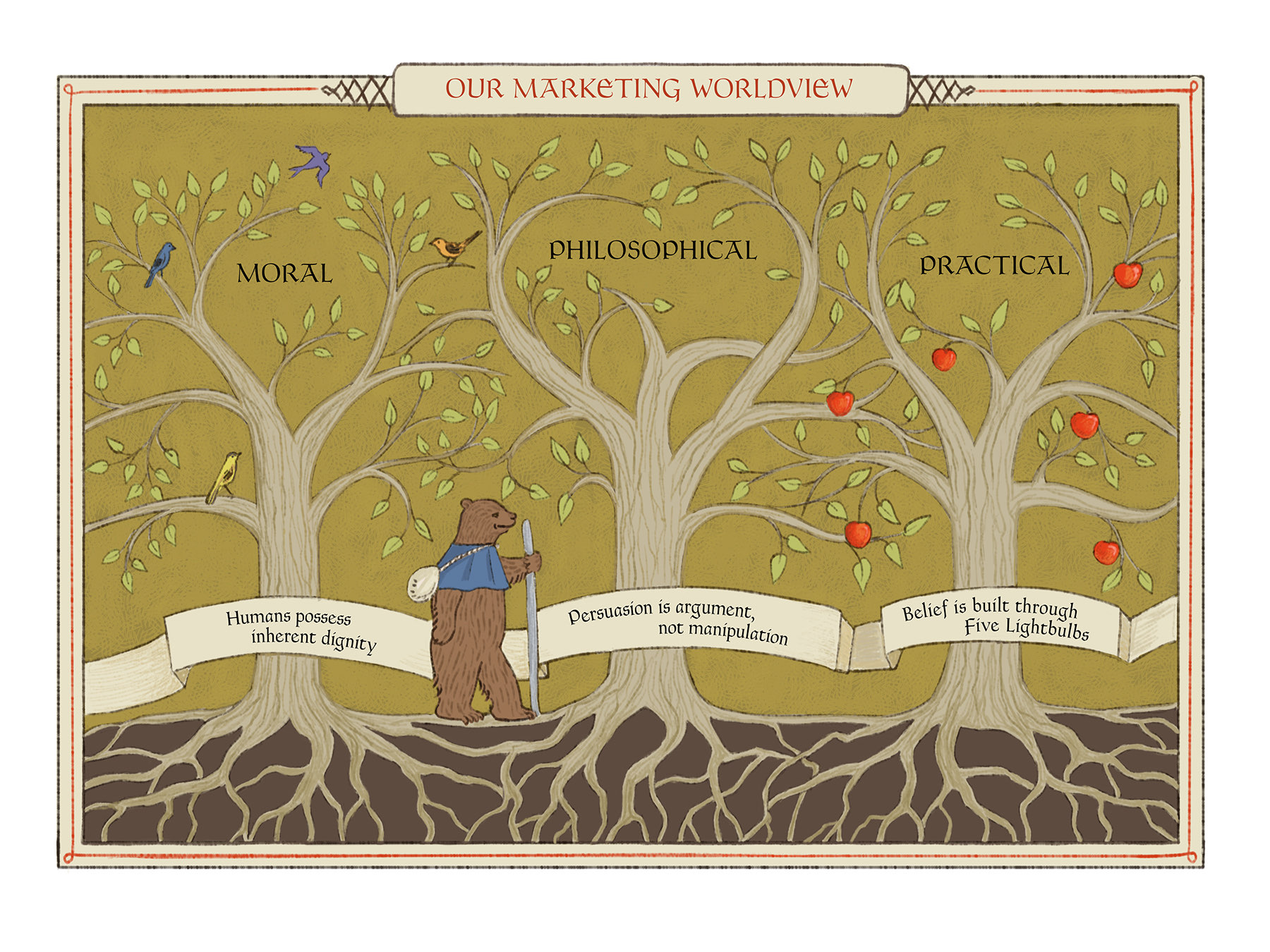
Here's how I think now about marketing, traced from worldview to daily practice:
Layer 1: The Moral Layer
We start with this axiom: Humans are born with inherent dignity.
This axiom does not depend on any particular worldview to function. It's a starting point many worldviews arrive at independently, because without it, people collapse into a means to an end, instead of an end in themselves.
The disagreement is rarely whether humans have dignity, but why.
For me, this axiom comes from Christianity. The Christian worldview assumes we are made in the image of God, a concept called Imago Dei. Therefore, humans are sacred. We must treat each other with respect and dignity.
Other worldviews arrive at this axiom for different reasons, with both religious and secular paths. Immanuel Kant would agree with this axiom, though not for the same reason Christians do.
The foundational axiom—Humans are born with inherent dignity that doesn't need to be earned, and cannot be taken away—answers the ontology question right from the start.
Utility, and asking "What works?" comes next.
Layer 2: The Philosophical Layer
Because humans are born with dignity, we should treat them as intelligent, capable of understanding an argument, and able to make decisions based on reason.
Sure, humans can act irrational at times. But we've also painted the Mona Lisa, built cathedrals, and traveled to the moon.
It's more accurate to say that humans are rational animals whose reasoning is often incomplete, distracted, or conflicted by emotion, habit, desire, and context.
Citing buyer irrationality to justify manipulative tactics is like saying "people are flammable, so let's give them a match."
Humans are clearly capable of higher reasoning, so why not treat them as such? Why not appeal to people's better nature rather than their baser instincts?
That is why the philosophy we employ in marketing is to build arguments.
This leads us to a new definition of marketing:
Marketing is the broadcast of a strong argument.
When most people hear the word "argument", they picture yelling voices and slammed doors.
That's not what we mean. In other languages, there are two different words: one for fighting, one for reasoning. Unfortunately, English collapses these two meanings into one.
We're using the second meaning: a structured attempt to show a person why something is true.
Not manipulation. Not behavior shaping. Not hacking brains.
Presenting an argument.
A good argument leads to belief. Belief leads to trust. Trust leads to relationship.
Layer 3: The Practical Layer
If human dignity is the axiom, and argumentation the method, then the practical tool must reflect both.
We need a framework that defaults to argumentation. It must treat every piece of communication as a reasoned appeal to an intelligent person.
If I finished here, I'd leave you stranded. You'd say, "This sounds nice, Billy, but I have a product launch approaching, a website to update, and emails to write."
I hear you.
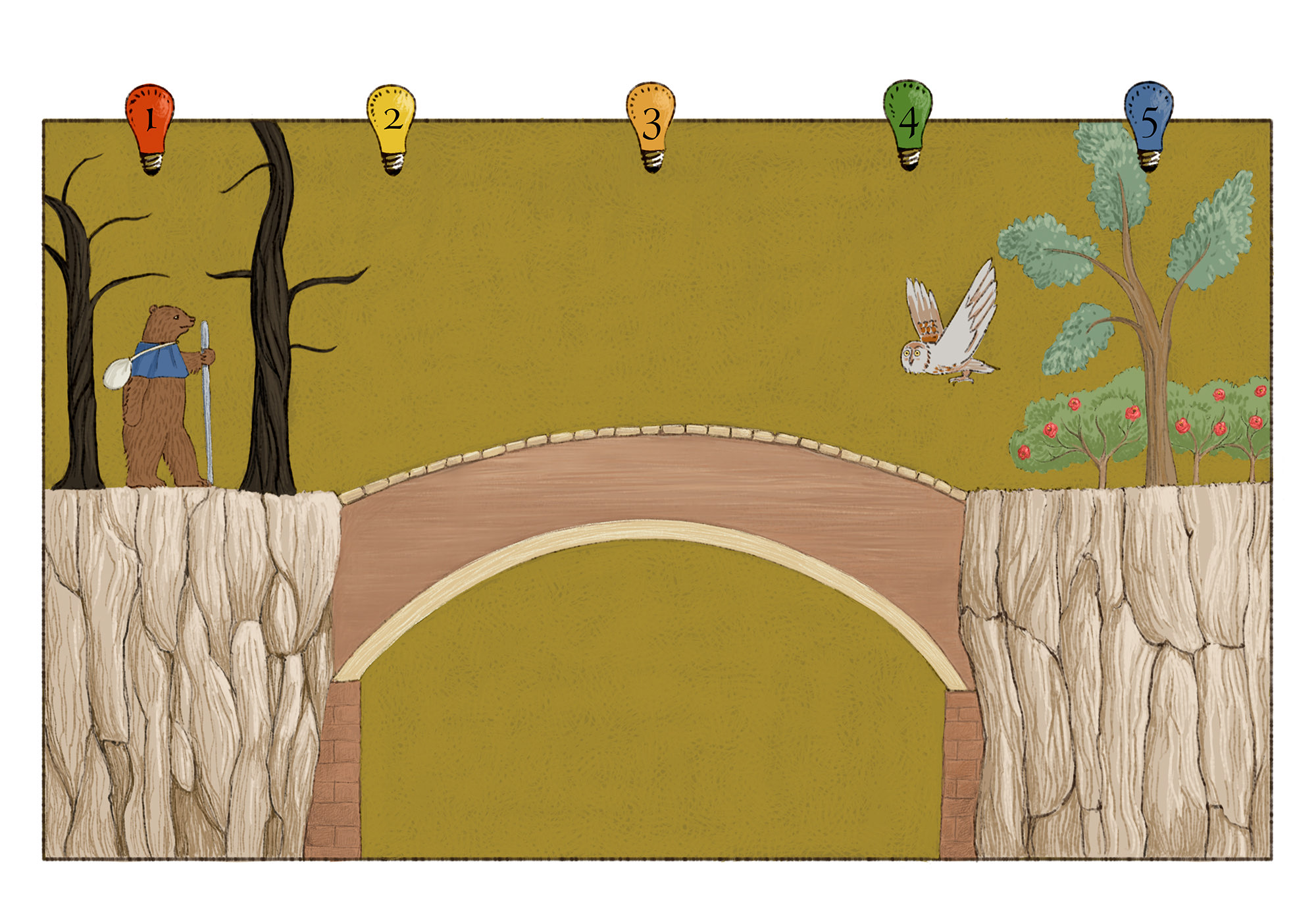
If marketing is argument, then the practical question becomes: what must a person believe in order to cross the gap from where they are to where they want to be?
X. Five Arguments Across the Gap
When marketing respects a person's ability to reason, we discover our true job: to build belief.
For a customer to cross the gap from where they are now to where they want to be, five specific beliefs must light up. These beliefs are not tricks, stages, or psychological levers. They are simply what the human mind requires when it is treated as a mind.
The beliefs your customer needs:
- "They get me." The customer is seen, their problem is named and articulated accurately.
- "The usual ways fall short." Existing options are weighed and found lacking. Not through throwing rocks or fear-mongering, but through clear comparison and honest evaluation.
- "This approach is different, and right for you." The product's underlying mechanism is explained and understood. The customer grasps why this works, not just that it works.
- "I trust them to deliver it." The business's credibility is established through integrity, consistency, and track record.
- "That's the future I actually want." The promised outcome is aligned with what the customer wants. Not an inflated promise, but a believable next chapter.
When all five beliefs are present and aligned, the decision is no longer a sale.
It is recognition.
I call this one framework the Five Lightbulbs. Look at how it reflects all three layers:
It honors the moral layer because we're making an argument. When you make an argument, you assume the person on the other end can understand it.
It embodies the philosophical layer because every Lightbulb is a belief that gets built through reasoned appeal.
It serves the practical layer because you can use it immediately: across websites, emails, podcasts, and videos.
This is what a "lightbulb moment" was always meant to represent. It's more than just an "aha." Light has always symbolized understanding, something that points beyond mere matter and chemicals, toward meaning.
Five clear arguments. Five moments of recognition. One bridge built.
Light by light, the bridge appears, and the soul crosses of its own accord.
XI. Re-Enchanting the Market
The response to the Great Human Flattening, at least with regards to marketing, starts with a simple choice:
Instead of exploiting people's psychology, we must appeal to their better nature with a clear argument.
We must teach them something true, invite reflection instead of reaction, assume their intelligence (not their gullibility), and help them become the kind of person they want to be.
Fear, urgency, and FOMO might work. But "it works" was never the question.
And if you've been following the conventional advice, not out of malice, but because it's what we were all taught, know that there's another way.
The future of marketing isn't in more psychological tricks. It's in better arguments.
Going forward, we must connect our promises to our practices.
Aspirational? Yes. Difficult? Yes.
But should we abandon our ideals just because they're hard to reach?
Every email you write, every page you publish, every conversation you have with a potential customer: these are moral acts, not just tactical ones.
Yes, argumentation is slower than manipulation. But the people who respond to argument, who are moved by truth rather than triggered by hacks, become better customers. They stay longer, complain less, and refer others.
Perhaps the only reason we need: it honors the person on the other end by telling them the truth.
To make an argument is to say: I believe you are capable of understanding the truth, and I will respect you enough to offer it honestly.
At its best, marketing is a good, true, and beautiful argument.